
From still
to story.
Every film is different. The creative process behind it is often the same.
An idea becomes a visual foundation, then a carefully directed moment in motion. Here is the recurring workflow — and a real example you can study or adapt.
Four stages.
Many possible worlds.
Create the frames
Develop the idea, composition, subject, light and atmosphere. Start with a strong image; sometimes define an end image too.
Direct the motion
Translate the intended action into precise timing, camera, material, continuity and sound instructions.
Generate & compare
Use Google Flow to generate variations, assess what works and iterate where the visual logic breaks.
Edit & finish
Choose the strongest take, remove weak moments, refine rhythm and continuity, and prepare the final film.
Give the world
a visual logic.
The first image establishes composition, perspective, environment, colour and atmosphere. A defined end frame can anchor a very specific reveal. ChatGPT image generation or Midjourney may be used to develop the visual foundation.

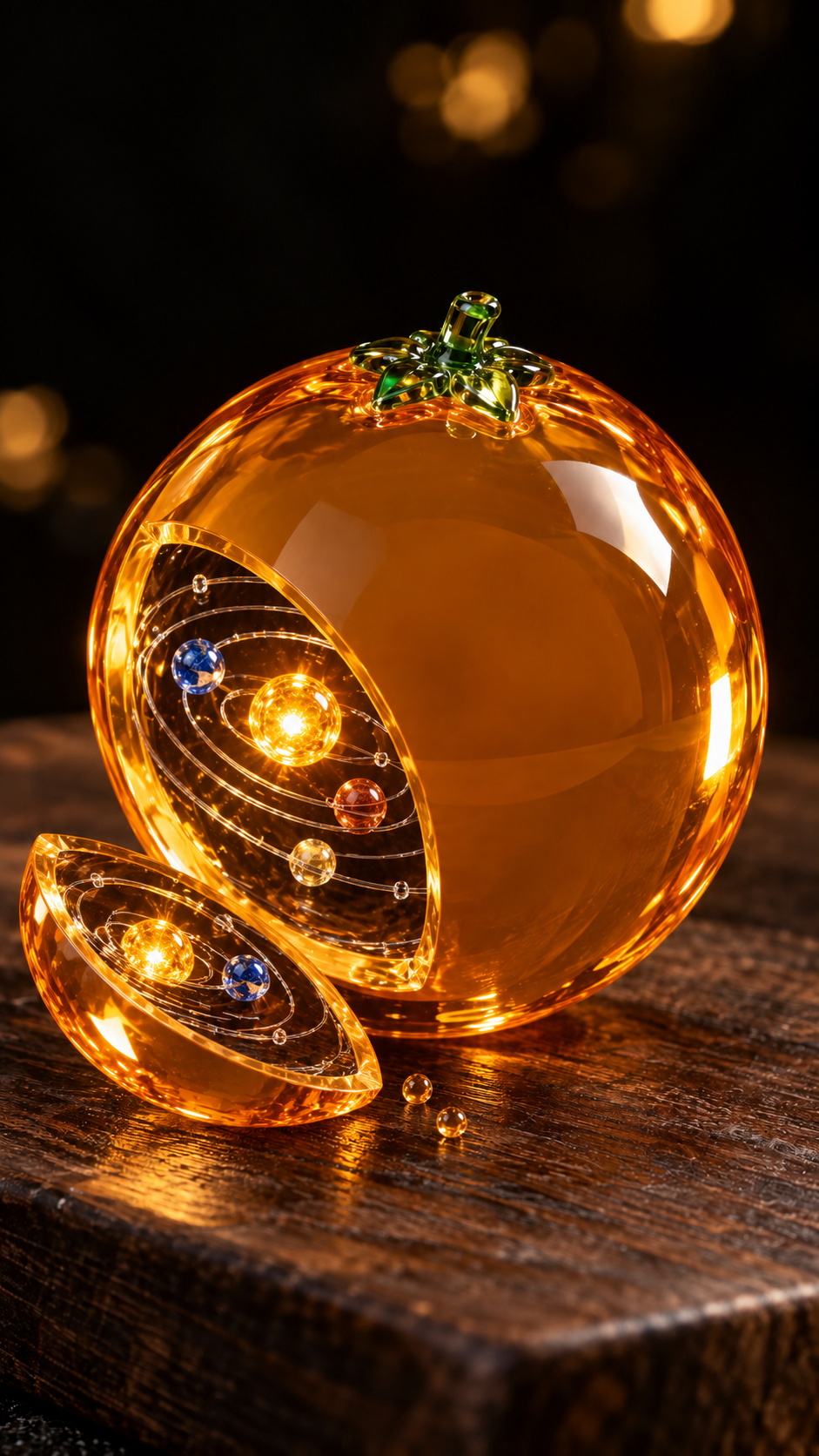
Citrine Solar Orange — the start and end frames of the finished film shown below.
Describe what moves.
And what must not.
I use ChatGPT to help turn the intended shot into a production prompt. The important details are not only the action, but timing, camera, material behaviour, object permanence and a clear ending. These constraints help prevent unwanted morphing or disappearing elements.
Real production prompt · Citrine Solar Orange
Static macro shot. The chef’s knife completes one slow, controlled shallow curved cut through the rigid citrine-orange glass orange. The orange stays hard optical glass with its transparent radial segments. One thin curved slice fully separates, falls gently to the lower-left of the walnut board and settles flat. The knife withdraws and the hand exits.
The exposed cut face reveals a miniature solar-system chamber made entirely of hard glass: a small citrine sun, one delicate transparent ring and three tiny coloured glass planets on precise orbital lines, framed by honey-gold crystal facets. The detached slice visibly continues the same solar structure. End exactly on the supplied end frame.
Native close-miked ASMR only: delicate metal-on-glass contact, fine crystal micro-cracks, one rich clean snap at separation, one muted glass-on-walnut landing, then two small bright ticks. No music, voice, whooshes, explosion or cartoon shatter.
Test the motion.
Choose the start frame, add an end frame when it helps, and provide the video prompt. Generate, compare variations and refine the direction. A single generation is not automatically the final film.
The final judgement
is still human.
I compare takes, look for visual errors, remove moments that break continuity, and refine timing, transitions and sound. ChatGPT can help analyse the generated clips and surface weaknesses, but selection and final direction remain creative decisions.
One idea.
Fully revealed.
The start frame, end frame and finished film all belong to Citrine Solar Orange. Watch the controlled cut reveal a miniature glass solar system, with close-miked ASMR shaping the moment.
Try the workflow
yourself.
Use this adaptable framework as a starting point. Replace every bracketed field with specific visual decisions. Keep the action achievable in one shot, then refine the prompt after comparing real generations.
Adaptable prompt framework
Create a cinematic [DURATION]-second video from the supplied start frame of [SUBJECT] in [ENVIRONMENT].

Action: [PRECISE ACTION] unfolds in this order: [BEAT 1], [BEAT 2], [BEAT 3].
Camera: [SHOT SIZE, ANGLE AND CAMERA MOVEMENT].
Environment: [BACKGROUND / ATMOSPHERIC MOTION].
Light and colour: [LIGHT SOURCE, QUALITY AND PALETTE].
Physical behaviour: [MATERIAL, WEIGHT, CONTACT AND SOUND DETAILS].
Continuity: maintain the original composition, subject identity, scale, perspective and object permanence. [WHAT MUST REMAIN UNCHANGED]. If an end frame is supplied, arrive at it cleanly and exactly.
Avoid: [WHAT MUST NOT HAPPEN — for example morphing, extra objects, disappearing details, camera cuts or exaggerated effects].
Sound: [NATIVE SOUND / MUSIC DIRECTION / SILENCE].
Free to use. No sign-up required.